
 Image 1 of 1
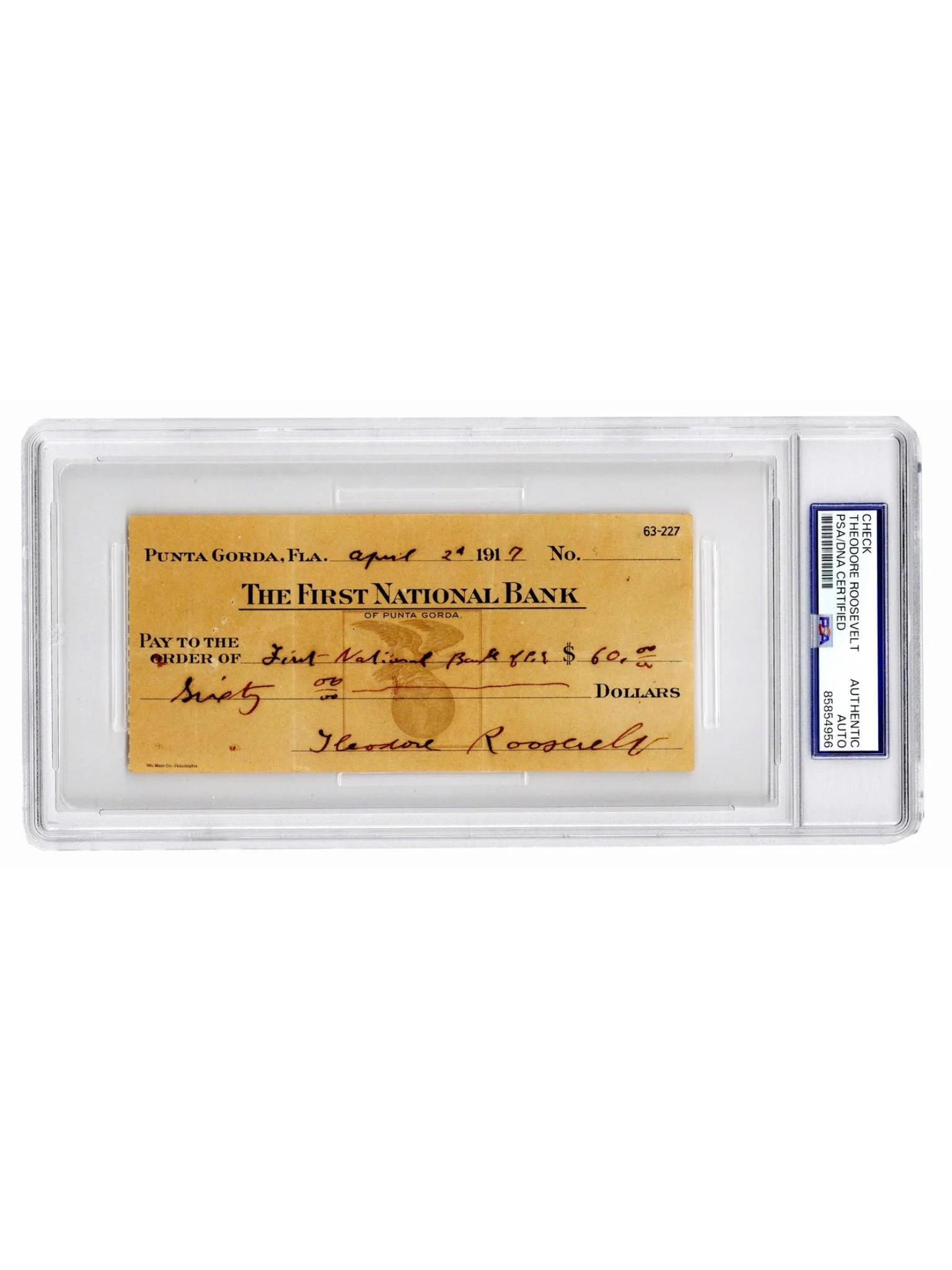
26th President. Bank check signed "Theodore Roosevelt", April 2, 1917, drawn from The First National Bank of Punta Gorda, payable to the "First National Bank of P.G." for $60. The engrossment is in the hand of the former President.
Presented further authenticated and encapsulated by PSA/DNA with an additional Letter of Authenticity from James Spence Authentication / JSA
The check is dated to the end of Roosevelt's deep-sea fishing expedition in Gulfside southern Florida in late March and early April 1917. An experienced hunter of big game on four continents, Roosevelt had set his sights on giant manta rays, or "devilfish," as they were termed by folksy locals. The ex-president joined up with Russell J. Coles, an ichthyologist from Danville, Virginia, along with Captain Jack J. McCann and the crew of the "E.C. Knight." After arriving in Punta Gorda on March 25th, Roosevelt and his crewmates traveled about 30 miles south into the Gulf of Mexico around Captiva Island. There, Roosevelt and his companions harpooned and captured a giant manta ray with a wingspan of nearly 17' which weighed hundreds of pounds.
Roosevelt did a little sight-seeing at the bird rookeries at nearby Matlacha before returning to Punta Gorda in early April. While in Florida, the former President addressed crowds of well-wishers while drumming up support for the latent American war effort. He criticized pacificists for allowing America to be "kicked [around] with impunity" and called the Germans murderers for having torpedoed the Lusitania. Roosevelt persuaded Floridians to join a just cause, explaining he was en route to Washington, D.C. to attend the special session of Congress planned for April 2, 1917 (the date of this very check). The United States declared war on Germany on April 6, 1917.
The Colonel had a personal stake in the war declaration; he had very publicly volunteered to personally recruit, mobilize, and deploy privately organized military units overseas in outfits much like his celebrated "Rough Riders" of the Spanish-American War. In March 1917, Congress had authorized Roosevelt to raise a maximum of four divisions for service in Europe. Roosevelt was absolutely devastated when, in mid-May 1917, President Wilson declined his offer.
26th President. Bank check signed "Theodore Roosevelt", April 2, 1917, drawn from The First National Bank of Punta Gorda, payable to the "First National Bank of P.G." for $60. The engrossment is in the hand of the former President.
Presented further authenticated and encapsulated by PSA/DNA with an additional Letter of Authenticity from James Spence Authentication / JSA
The check is dated to the end of Roosevelt's deep-sea fishing expedition in Gulfside southern Florida in late March and early April 1917. An experienced hunter of big game on four continents, Roosevelt had set his sights on giant manta rays, or "devilfish," as they were termed by folksy locals. The ex-president joined up with Russell J. Coles, an ichthyologist from Danville, Virginia, along with Captain Jack J. McCann and the crew of the "E.C. Knight." After arriving in Punta Gorda on March 25th, Roosevelt and his crewmates traveled about 30 miles south into the Gulf of Mexico around Captiva Island. There, Roosevelt and his companions harpooned and captured a giant manta ray with a wingspan of nearly 17' which weighed hundreds of pounds.
Roosevelt did a little sight-seeing at the bird rookeries at nearby Matlacha before returning to Punta Gorda in early April. While in Florida, the former President addressed crowds of well-wishers while drumming up support for the latent American war effort. He criticized pacificists for allowing America to be "kicked [around] with impunity" and called the Germans murderers for having torpedoed the Lusitania. Roosevelt persuaded Floridians to join a just cause, explaining he was en route to Washington, D.C. to attend the special session of Congress planned for April 2, 1917 (the date of this very check). The United States declared war on Germany on April 6, 1917.
The Colonel had a personal stake in the war declaration; he had very publicly volunteered to personally recruit, mobilize, and deploy privately organized military units overseas in outfits much like his celebrated "Rough Riders" of the Spanish-American War. In March 1917, Congress had authorized Roosevelt to raise a maximum of four divisions for service in Europe. Roosevelt was absolutely devastated when, in mid-May 1917, President Wilson declined his offer.