
 Image 1 of 2
 Image 2 of 2
Schuyler Colfax & 50 Republican Congressmen 1863 Letter Signed to President Abraham Lincoln
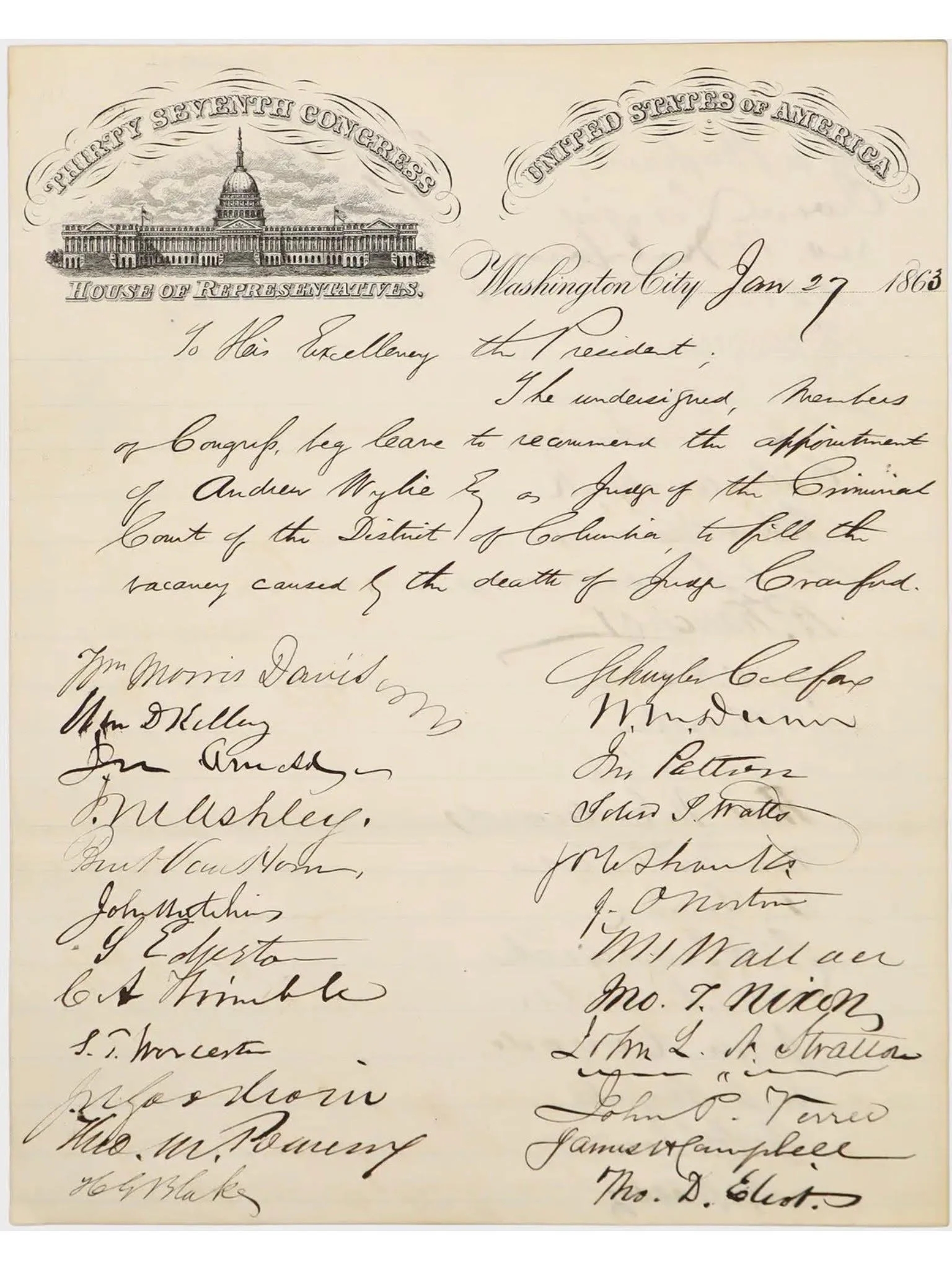
** Letter to Abraham Lincoln for the Appointment of Andrew Wylie as Judge of the Criminal Court of the District of Columbia, Signed by 51 Members of the Thirty Seventh Congress of the United States. **
A petition for President Lincoln to appoint Andrew Wylie as Judge of the Criminal Court of the District of Columbia, January 27, 1863, on 8×10 decorative Congressional stationery. The body is in the hand of future Vice President Schuyler Colfax and reads:
To His Excellency the President:
The undersigned, members of Congress, beg leave to recommend the appointment of Andrew Wylie Esq. as Judge of the Criminal Court of the District of Columbia, to fill the vacancy caused by the death of Judge Crawford.
It is then signed by Colfax and 50 additional Republican members of the House of Representatives.
Wylie was nominated by President Abraham Lincoln to the Supreme Court of the District of Columbia on March 10, 1863, and was confirmed by the Senate on March 12, 1863. However, the Senate voted to reconsider the confirmation on March 13, 1863, with no subsequent Senate vote. His nomination expired on March 14, 1863, with the sine die adjournment of the special session of the 38th United States Congress.
Wylie received a recess appointment from President Lincoln on March 18, 1863, to the Supreme Court of the District of Columbia (now the United States District Court for the District of Columbia), to a new associate justice seat authorized by 12 Stat. 762. He was nominated to the same position by President Lincoln on January 5, 1864. He was confirmed by the United States Senate on January 20, 1864, and received his commission the same day. His service ended after his retirement on May 1, 1885.
Docketed on integral address leaf.
An amazing piece of Lincoln memorabilia as it contains the signatures of 51 Republican Congressmen - nearly half of the entire Republican House contingent. The southern rebellion which followed Abraham Lincoln’s election to the presidency gave Republicans control of the 37th Congress (1861–1863). Congress, led by a vocal minority of Radical Republicans, backed Lincoln on nearly every legislative front: the southern naval blockade; the call for volunteers; the federal spending blitz; and the suspension of habeas corpus. Freed to act without southern obstructionism, Congress passed a long succession of bills with far-reaching consequences for the country’s growth in later decades: the establishment of an Agriculture Department, the Homestead Act, the Pacific Railroad Act, and the land-grant college system.
Signatures consist of:
Schuyler Colfax - Indiana (R)
William Morris Davis - Pennsylvania (R)
William D. Kelley - Pennsylvania (R)
Isaac N. Arnold - Illinois (R)
James M. Ashley - Ohio (R)
Burt Van Horn - New York (R)
John Hutchins - Ohio (R)
Sidney Edgerton - Ohio (R)
Carey A. Trimble - Ohio (R)
Samuel T. Worcester - Ohio (R)
John N. Goodwin - Maine (R)
Theodore M. Pomeroy - New York (R)
Harrison G.O. Blake - Ohio (R)
William M. Dunn - Indiana (R)
John Patton - Pennsylvania (R)
John S. Watts - New Mexico Territory (R)
John P.C. Shanks - Indiana (R)
unidentified
William H. Wallace - Washington Territory (R)
John T. Nixon - New Jersey (R)
John L.N. Stratton - New Jersey (R)
John P. Verree - Pennsylvania (R)
James H. Campbell - Pennsylvania (R)
Thomas D. Eliot - Massachusetts (R)
John Bingham - Ohio (R)
Owen Lovejoy - Illinois (R)
George W. Julian - Indiana (R)
Albert G. Porter - Indiana (R)
Edward McPherson - Pennsylvania (R)
James B. McKean - New York (R)
Rowland E. Trowbridge - Michigan (R)
Charles H. Van Wyck - New York (R)
A. Scott Sloan - Wisconsin (R)
William E. Lansing - New York (R)
Richard Franchot - New York (R)
Cyrus Aldrich - Minnesota (R)
unidentified
Edward H. Rollins - New Hampshire (R)
Thomas M. Edwards - New Hampshire (R)
unidentified
Dwight Loomis - Connecticut (R)
Charles Sedgwick - New York (R)
Albert G. Riddle - Ohio (R)
John Covode - Pennsylvania (R)
Aaron A. Sargent - California (R)
Frederick F. Low - California (R)
Samuel L. Casey - Kentucky (UU)
Thomas A.D. Fessenden - Maine (R)
Samuel G. Daily - Nebraska Territory (R)
John F. Potter - Wisconsin (R)
James K. Moorhead - Pennsylvania (R)
** Letter to Abraham Lincoln for the Appointment of Andrew Wylie as Judge of the Criminal Court of the District of Columbia, Signed by 51 Members of the Thirty Seventh Congress of the United States. **
A petition for President Lincoln to appoint Andrew Wylie as Judge of the Criminal Court of the District of Columbia, January 27, 1863, on 8×10 decorative Congressional stationery. The body is in the hand of future Vice President Schuyler Colfax and reads:
To His Excellency the President:
The undersigned, members of Congress, beg leave to recommend the appointment of Andrew Wylie Esq. as Judge of the Criminal Court of the District of Columbia, to fill the vacancy caused by the death of Judge Crawford.
It is then signed by Colfax and 50 additional Republican members of the House of Representatives.
Wylie was nominated by President Abraham Lincoln to the Supreme Court of the District of Columbia on March 10, 1863, and was confirmed by the Senate on March 12, 1863. However, the Senate voted to reconsider the confirmation on March 13, 1863, with no subsequent Senate vote. His nomination expired on March 14, 1863, with the sine die adjournment of the special session of the 38th United States Congress.
Wylie received a recess appointment from President Lincoln on March 18, 1863, to the Supreme Court of the District of Columbia (now the United States District Court for the District of Columbia), to a new associate justice seat authorized by 12 Stat. 762. He was nominated to the same position by President Lincoln on January 5, 1864. He was confirmed by the United States Senate on January 20, 1864, and received his commission the same day. His service ended after his retirement on May 1, 1885.
Docketed on integral address leaf.
An amazing piece of Lincoln memorabilia as it contains the signatures of 51 Republican Congressmen - nearly half of the entire Republican House contingent. The southern rebellion which followed Abraham Lincoln’s election to the presidency gave Republicans control of the 37th Congress (1861–1863). Congress, led by a vocal minority of Radical Republicans, backed Lincoln on nearly every legislative front: the southern naval blockade; the call for volunteers; the federal spending blitz; and the suspension of habeas corpus. Freed to act without southern obstructionism, Congress passed a long succession of bills with far-reaching consequences for the country’s growth in later decades: the establishment of an Agriculture Department, the Homestead Act, the Pacific Railroad Act, and the land-grant college system.
Signatures consist of:
Schuyler Colfax - Indiana (R)
William Morris Davis - Pennsylvania (R)
William D. Kelley - Pennsylvania (R)
Isaac N. Arnold - Illinois (R)
James M. Ashley - Ohio (R)
Burt Van Horn - New York (R)
John Hutchins - Ohio (R)
Sidney Edgerton - Ohio (R)
Carey A. Trimble - Ohio (R)
Samuel T. Worcester - Ohio (R)
John N. Goodwin - Maine (R)
Theodore M. Pomeroy - New York (R)
Harrison G.O. Blake - Ohio (R)
William M. Dunn - Indiana (R)
John Patton - Pennsylvania (R)
John S. Watts - New Mexico Territory (R)
John P.C. Shanks - Indiana (R)
unidentified
William H. Wallace - Washington Territory (R)
John T. Nixon - New Jersey (R)
John L.N. Stratton - New Jersey (R)
John P. Verree - Pennsylvania (R)
James H. Campbell - Pennsylvania (R)
Thomas D. Eliot - Massachusetts (R)
John Bingham - Ohio (R)
Owen Lovejoy - Illinois (R)
George W. Julian - Indiana (R)
Albert G. Porter - Indiana (R)
Edward McPherson - Pennsylvania (R)
James B. McKean - New York (R)
Rowland E. Trowbridge - Michigan (R)
Charles H. Van Wyck - New York (R)
A. Scott Sloan - Wisconsin (R)
William E. Lansing - New York (R)
Richard Franchot - New York (R)
Cyrus Aldrich - Minnesota (R)
unidentified
Edward H. Rollins - New Hampshire (R)
Thomas M. Edwards - New Hampshire (R)
unidentified
Dwight Loomis - Connecticut (R)
Charles Sedgwick - New York (R)
Albert G. Riddle - Ohio (R)
John Covode - Pennsylvania (R)
Aaron A. Sargent - California (R)
Frederick F. Low - California (R)
Samuel L. Casey - Kentucky (UU)
Thomas A.D. Fessenden - Maine (R)
Samuel G. Daily - Nebraska Territory (R)
John F. Potter - Wisconsin (R)
James K. Moorhead - Pennsylvania (R)