
 Image 1 of 1
Ronald Reagan 1987 Typed Letter Signed as President - Quoting Abraham Lincoln & Invoking His Belief In, And Reliance On, God
Amidst the worst scandal of his administration, the Iran/Contra Affair, he denounces his opponents as a lynch mob, and celebrates his emerging personally untouched from the scandal
An extraordinary letter, with references to God, Lincoln, and Iran/Contra, and surely one of the best Reagan letter extant
40th President.
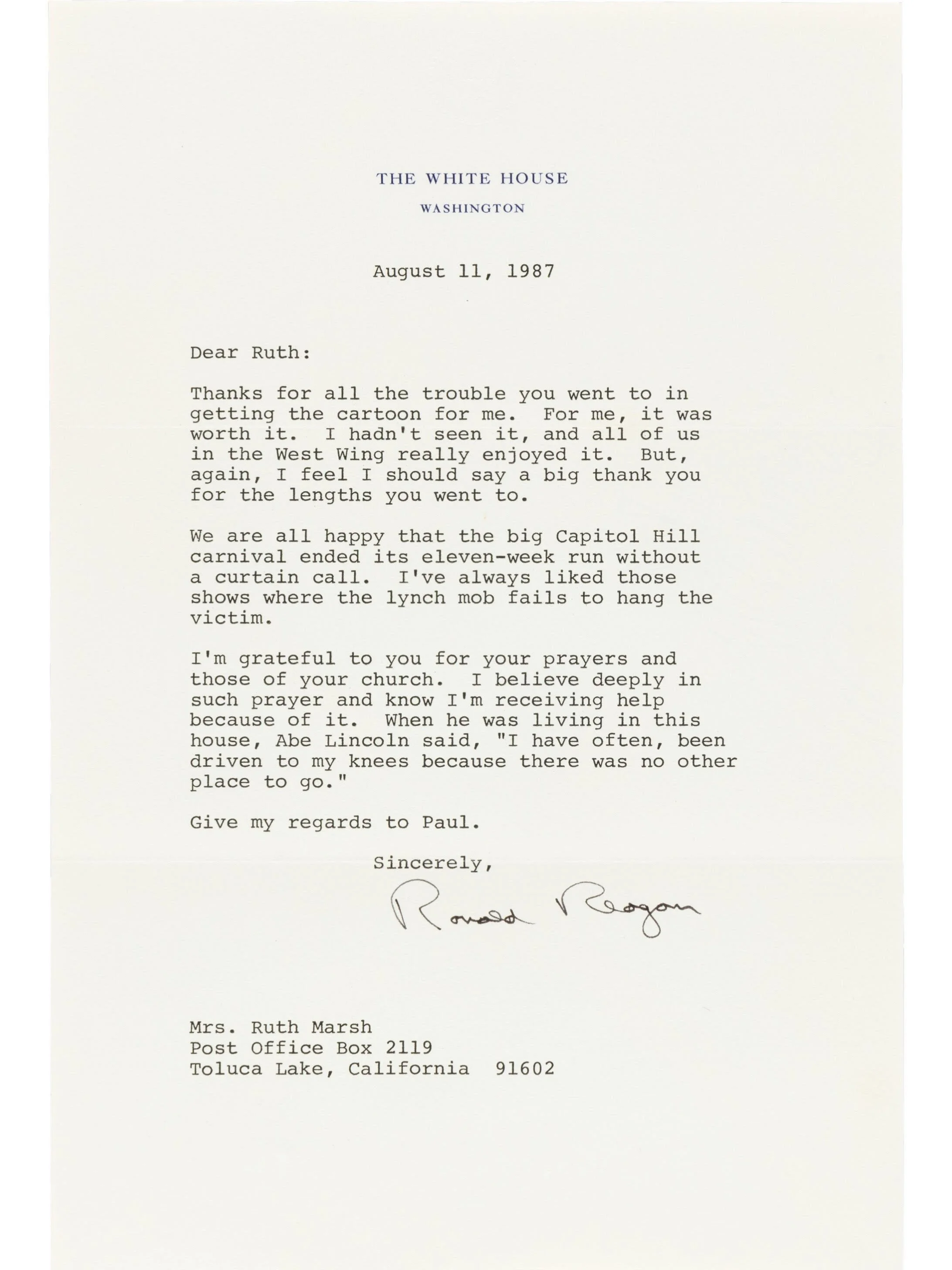
Typed letter signed “Ronald Reagan” AS PRESIDENT, on White House letterhead, Washington, August 11, 1987, to Mrs. Ruth Marsh, in the wake of the Tower Commission and other investigations not finding Reagan criminally liable, in full:
Thanks for all the trouble you went to in getting the cartoon for me. For me, it was worth it. I hadn’t seen it, and all of us in the West Wing really enjoyed it. But, again, I feel I should say a big thank you for the lengths you went to.
We are all happy that the big Capitol Hill carnival ended its eleven-week run without a curtain call. I’ve always liked those shows where the lynch mob fails to hang the victim.
I’m grateful to you for your prayers and those of your church. I believe deeply in such prayer and know I’m receiving help because of it. When he was living in this house, Abe Lincoln said, ‘I have often, been driven to my knees because there was no other place to go.’
Give my regards to Paul.
Sincerely,
Ronald Reagan.
This is a fascinating letter in a number of ways. Reagan compares himself to Lincoln, invokes his belief in and reliance on God, denounces his opponents as a lynch mob, and celebrates his emerging personally untouched from the scandal. Clearly one of the best Reagan letters on the marketplace.
The letter comes in the immediate aftermath of the televised Iran-Contra hearings, which had concluded just days earlier after an eleven-week run before Congress. His theatrical language-describing the proceedings as a "Capitol Hill carnival" reflects his view of the investigation as politically charged and adversarial.
President Reagan’s Daily Diary indicates that on January 8, 1987, Reagan spoke with Mrs. Paul Marsh to “thank Mrs. Marsh for her recent letter of support.” On July 6, 1987, Reagan spoke with Paul Marsh, presumably on a similar topic.
Reagan needed all the support he could get, as he was in the midst of the worst scandal of his administration – the Iran/Contra Affair. Senior officials of the Reagan administration secretly facilitated the sale of arms to the government of the Islamic Republic of Iran, despite Iran being the subject of an arms embargo. The administration hoped to use the proceeds of the arms sale to fund the revolutionary right wing Contras in Nicaragua. This despite the fact that further funding of the Contras by the U.S. government had been prohibited by Congress. The scandal broke in November 1986, and it became known that Reagan was aware of potential hostage transfers with Iran, as well as the sale of missiles to that country. Reagan appeared on national television and admitted that the weapons transfers had indeed occurred, but that the United States did not trade arms for hostages.
The affair was investigated by Congress, and also by the three-person, Reagan-appointed Tower Commission. Neither investigation found evidence that President Reagan himself knew of the extent of the multiple programs. The Tower Commission’s report, published on February 27, 1987, concluded that CIA Director William Casey, who supported the Iran-Contra arrangement, should have taken over the operation and made the President aware of the risks and notified Congress as legally required. The Commission’s report “held Reagan accountable for a lax managerial style and aloofness from policy detail.” Meanwhile, Deputy Attorney General Lawrence Walsh was appointed Independent Counsel in December 1986 to investigate possible criminal actions by officials involved in the scheme. In the end, several dozen administration officials were indicted, including then-Secretary of Defense Caspar Weinberger. Eleven convictions resulted, some of which were vacated on appeal.
On March 4, 1987, in a move to bring the scandal to an end, Reagan made a further nationally televised address, taking full responsibility for the affair and stating that “what began as a strategic opening to Iran deteriorated, in its implementation, into trading arms for hostages”.
Amidst the worst scandal of his administration, the Iran/Contra Affair, he denounces his opponents as a lynch mob, and celebrates his emerging personally untouched from the scandal
An extraordinary letter, with references to God, Lincoln, and Iran/Contra, and surely one of the best Reagan letter extant
40th President.
Typed letter signed “Ronald Reagan” AS PRESIDENT, on White House letterhead, Washington, August 11, 1987, to Mrs. Ruth Marsh, in the wake of the Tower Commission and other investigations not finding Reagan criminally liable, in full:
Thanks for all the trouble you went to in getting the cartoon for me. For me, it was worth it. I hadn’t seen it, and all of us in the West Wing really enjoyed it. But, again, I feel I should say a big thank you for the lengths you went to.
We are all happy that the big Capitol Hill carnival ended its eleven-week run without a curtain call. I’ve always liked those shows where the lynch mob fails to hang the victim.
I’m grateful to you for your prayers and those of your church. I believe deeply in such prayer and know I’m receiving help because of it. When he was living in this house, Abe Lincoln said, ‘I have often, been driven to my knees because there was no other place to go.’
Give my regards to Paul.
Sincerely,
Ronald Reagan.
This is a fascinating letter in a number of ways. Reagan compares himself to Lincoln, invokes his belief in and reliance on God, denounces his opponents as a lynch mob, and celebrates his emerging personally untouched from the scandal. Clearly one of the best Reagan letters on the marketplace.
The letter comes in the immediate aftermath of the televised Iran-Contra hearings, which had concluded just days earlier after an eleven-week run before Congress. His theatrical language-describing the proceedings as a "Capitol Hill carnival" reflects his view of the investigation as politically charged and adversarial.
President Reagan’s Daily Diary indicates that on January 8, 1987, Reagan spoke with Mrs. Paul Marsh to “thank Mrs. Marsh for her recent letter of support.” On July 6, 1987, Reagan spoke with Paul Marsh, presumably on a similar topic.
Reagan needed all the support he could get, as he was in the midst of the worst scandal of his administration – the Iran/Contra Affair. Senior officials of the Reagan administration secretly facilitated the sale of arms to the government of the Islamic Republic of Iran, despite Iran being the subject of an arms embargo. The administration hoped to use the proceeds of the arms sale to fund the revolutionary right wing Contras in Nicaragua. This despite the fact that further funding of the Contras by the U.S. government had been prohibited by Congress. The scandal broke in November 1986, and it became known that Reagan was aware of potential hostage transfers with Iran, as well as the sale of missiles to that country. Reagan appeared on national television and admitted that the weapons transfers had indeed occurred, but that the United States did not trade arms for hostages.
The affair was investigated by Congress, and also by the three-person, Reagan-appointed Tower Commission. Neither investigation found evidence that President Reagan himself knew of the extent of the multiple programs. The Tower Commission’s report, published on February 27, 1987, concluded that CIA Director William Casey, who supported the Iran-Contra arrangement, should have taken over the operation and made the President aware of the risks and notified Congress as legally required. The Commission’s report “held Reagan accountable for a lax managerial style and aloofness from policy detail.” Meanwhile, Deputy Attorney General Lawrence Walsh was appointed Independent Counsel in December 1986 to investigate possible criminal actions by officials involved in the scheme. In the end, several dozen administration officials were indicted, including then-Secretary of Defense Caspar Weinberger. Eleven convictions resulted, some of which were vacated on appeal.
On March 4, 1987, in a move to bring the scandal to an end, Reagan made a further nationally televised address, taking full responsibility for the affair and stating that “what began as a strategic opening to Iran deteriorated, in its implementation, into trading arms for hostages”.