
 Image 1 of 3
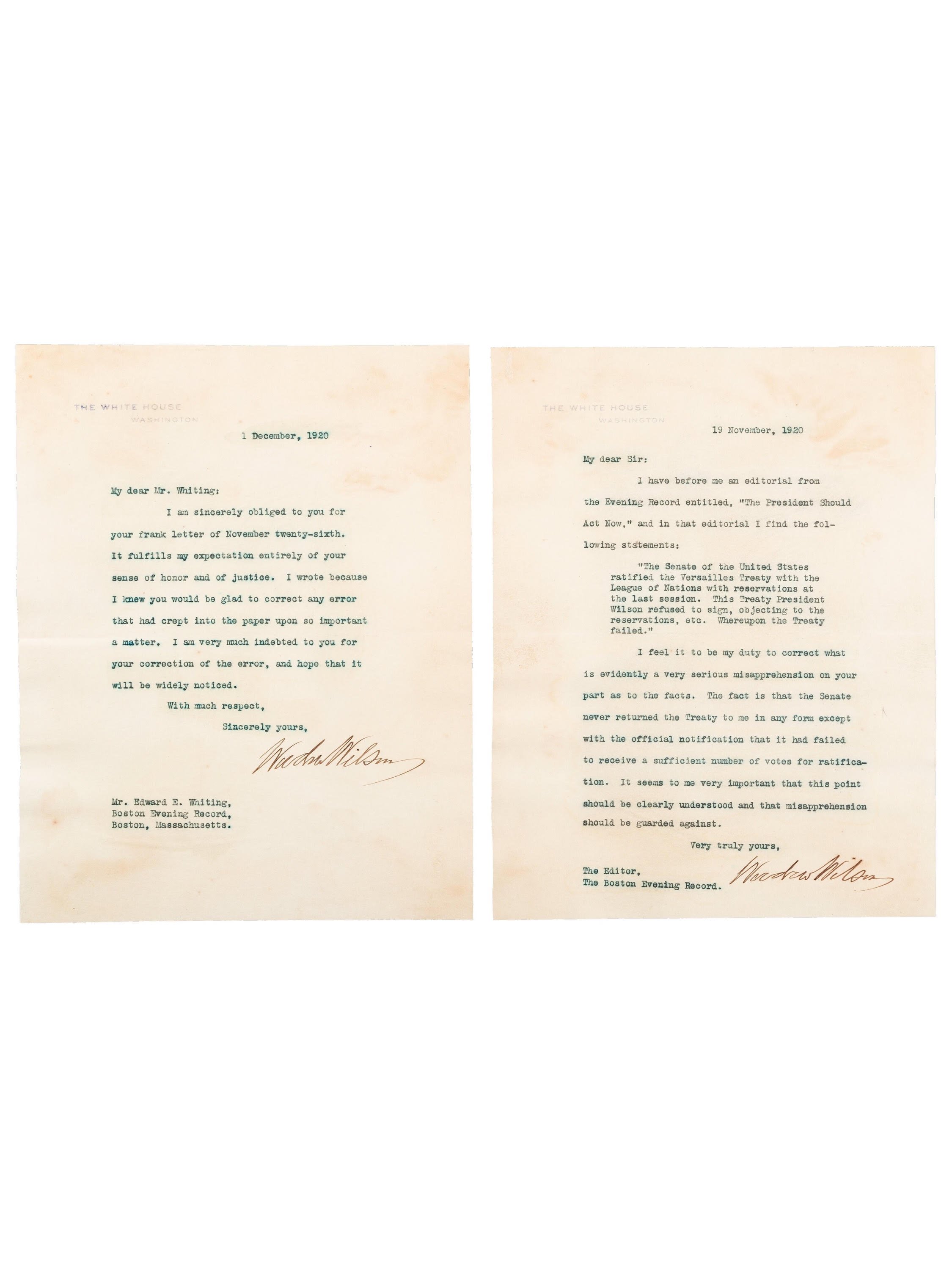 Image 2 of 3
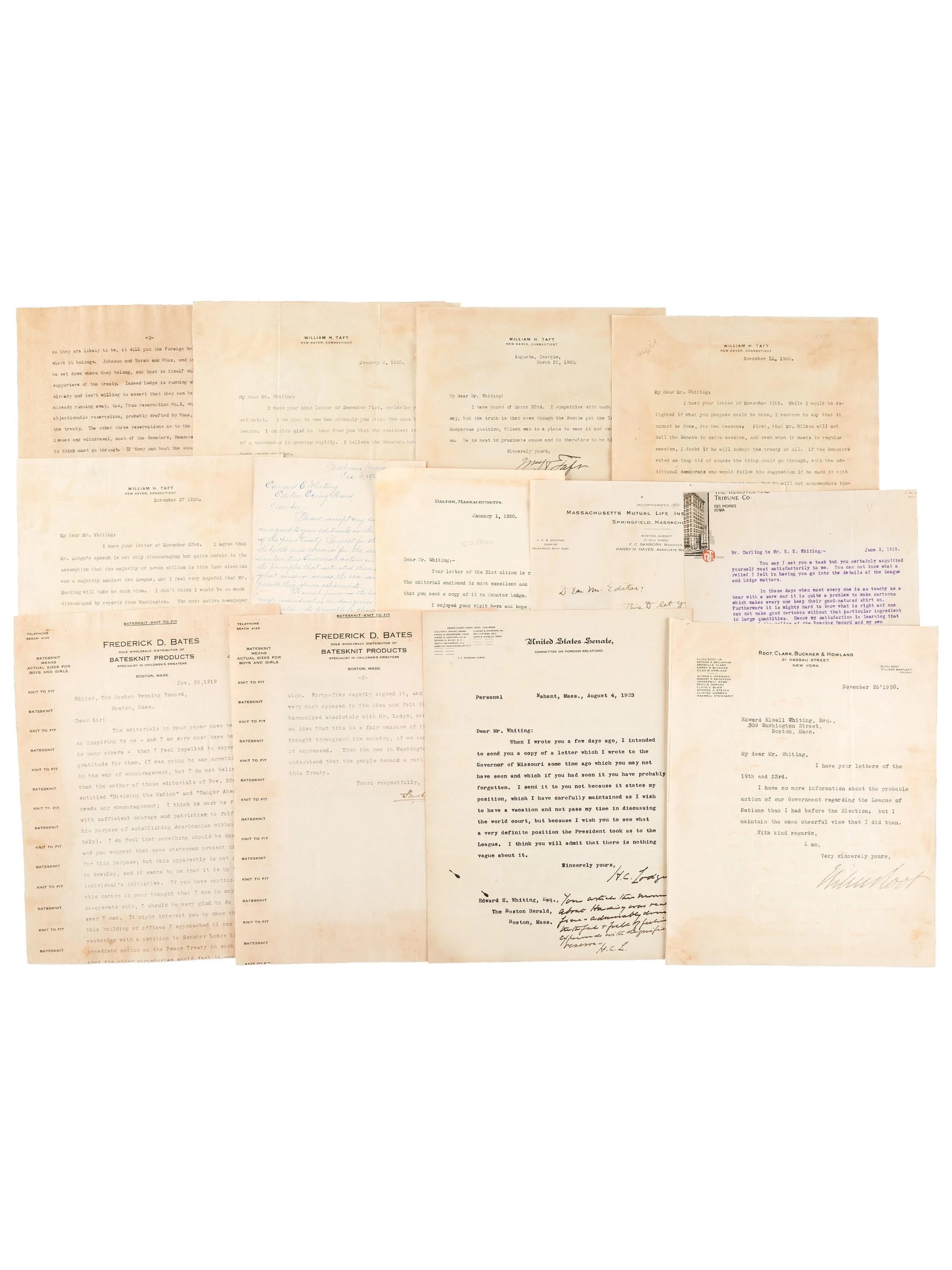 Image 3 of 3
(League Of Nations) Incredible Archive Regarding The League of Nations and the Treaty of Versailles - 17 Letters Signed by William H. Taft, 2 Signed by Woodrow Wilson & More
Incredible archive of correspondence from Presidents Woodrow Wilson and William Howard Taft, both writing to the editor of the Boston Evening Record, concerning the highly charged debate in the senate regarding the ratification of the Treaty of Versailles ending World War I
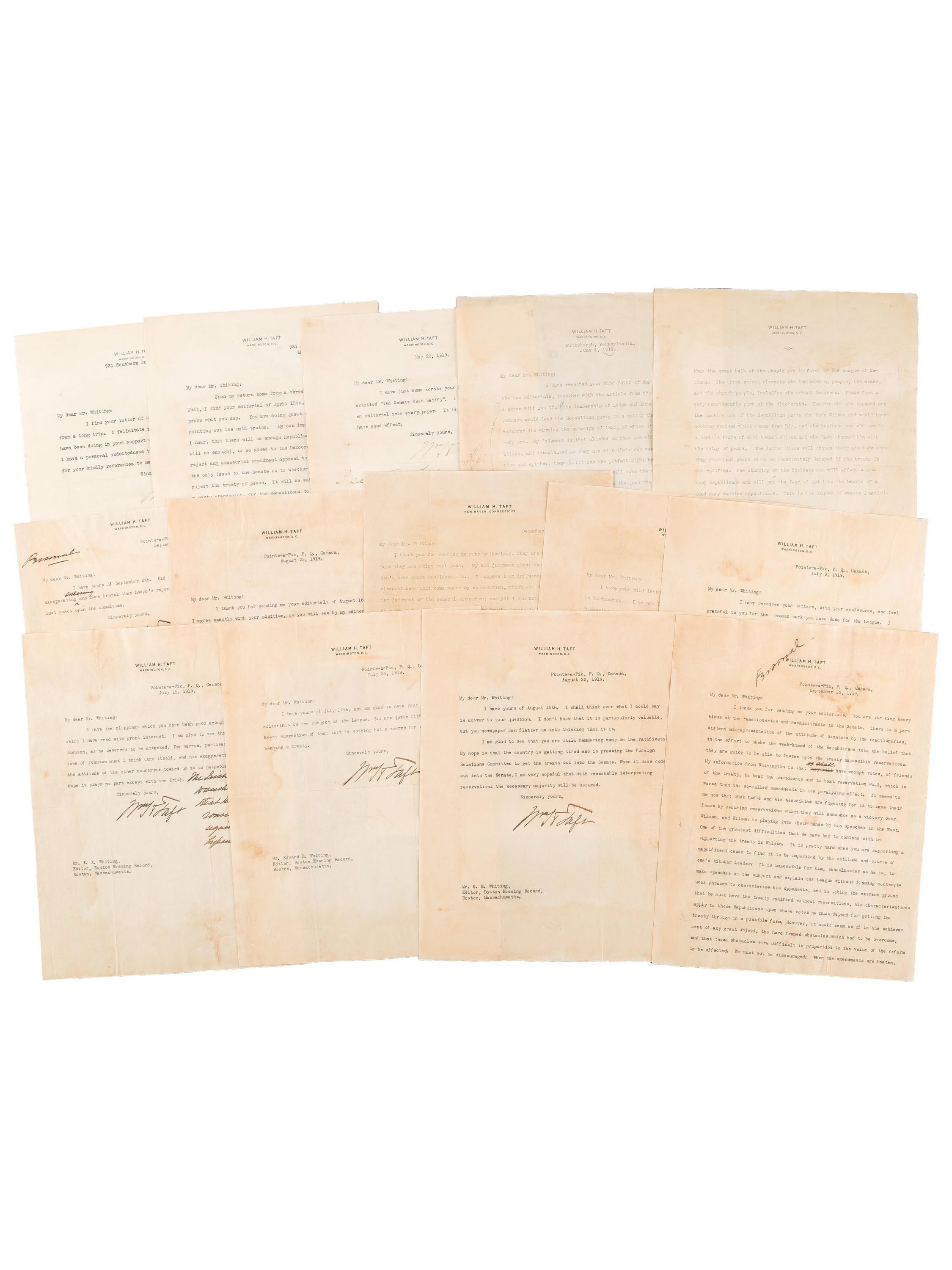
The archive consists of two (2) Woodrow Wilson typed letters signed as President, along with seventeen (17) typed letters signed by former President William Howard Taft, as well as two (2) by Henry Cabot Lodge as Senator, and one by Elihu Root - all written to Edward E. Whiting, Editor of The Boston Evening Record concerning the Treaty of Versailles and the League of Nations.
Wilson's letters are written in response to an editorial in The Boston Evening Record entitled "The President Should Act Now" which stated that the Senate "ratified the Versailles Treaty [which] President Wilson refused to sign." The seventeen letters from Taft begin on April 9, 1919 and continue through November 27, 1920. They exhibit incredible content concerning the political situation between President Wilson and the Senate about the ratification of the Treaty of Versailles, as well as the League of Nations.
Woodrow Wilson: Historic typed letter signed "Woodrow Wilson") as President, 1 page, (7 x 8.75 inches), The White House, November 19, 1920, to "The Editor [of] The Boston Evening Standard" [Edward E. Whiting]. Wilson writes, in full:
My dear Sir: I have before me an editorial from the Evening Record entitled, "The President Should Act Now," and in that editorial I find the following statements: The Senate of the United States ratified the Versailles Treaty with the League of Nations with reservations at the last session. This Treaty President Wilson refused to sign, objecting to the reservations, etc. Whereupon the Treaty failed.'
I feel it to be my duty to correct what is evidently a very serious misapprehension on your part as to the facts. The fact is that the Senate never returned the Treaty to me in any form except with the official notification that it had failed to receive a sufficient number of votes for ratification. It seems to me very important that this point should be clearly understood and that misapprehension should be guarded against. Very truly yours, Woodrow Wilson.
Woodrow Wilson: typed letter signed "Woodrow Wilson" as President, 1 page, (7 x 8.75 inches), The White House, December 1, 1920. Wilson writes, in full:
Mr. Whiting: I am sincerely obliged to you for your frank letter of November twenty-sixth. It fulfills my expectation entirely of your sense of honor and of justice. I wrote because I knew you would be glad to correct any error that had crept into the paper upon so important a matter. I am very much indebted to you for your correction of the error, and hope that it will be widely noticed. With much respect, Sincerely yours, Woodrow Wilson.
The Senate, on November 19, 1919, for the first time in its history, rejected a peace treaty. The Senate rejected the Treaty with 14 reservations added by Republican Senate Majority Leader Henry Cabot Lodge, by a vote of 39-55. The original Treaty of Versailles, with the League of Nations Covenant, was then rejected by the Senate, 38-53. After a motion to reconsider, the vote was 41-50. 61 votes, two-thirds of the Senators present, were needed for ratification. The treaty's defeat prompted a public outcry and made Senator Lodge the target of much criticism. In February 1920, the Senate felt compelled to take up the matter again. After lengthy debate, the Senate voted on the treaty with 15 reservations on March 19. Wilson had communicated his displeasure to Democratic senators, but his control over his party was waning. A number of Democrats deserted the president's position and voted in favor of the proposal, but the final tally of 49 in favor and 35 opposed was seven votes short of the required two-thirds total for ratification. In this instance, the loyalist Democrats teamed with the Irreconcilables to stop the measure.
The ratification of the Versailles Treaty and its provision for the League of Nations had become a bitter partisan issue. Many authorities believe that if a Republican had occupied the White House or perhaps a Democrat other than Wilson, the treaty would have gained approval. In May, Congress enacted a measure declaring a formal end to the war, but Wilson promptly vetoed it. The president remained resolute. He chose to take the matter to the electorate, asking that the election of 1920 be a "solemn referendum" on the treaty. Wilson's recent history of taking issues to the public had not been successful and this effort failed as well. Warren G. Harding and the Republicans won a smashing victory on a pledge of returning the country to "normalcy." Wilson slipped into a bitter and short retirement. A Congressional joint-resolution ended the war with Germany and Austria-Hungary in July 1921.
For the sake of brevity, the following are key excerpts taken from some of the letters written by former President William H. Taft to The Boston Evening Record Editor, Edward E. Whiting:
Typed letter signed, 2 pages, June 4, 1919. One of the finest Taft letters we have encountered. Within, Taft asserts, "the leadership of Lodge and Knox and Borah and Johnson would lead the Republican party to a policy that would seriously endanger its winning the campaign of 1820... pressure from the country to ratify will become so strong that [Republican Senators] will conclude the best thing to do is to ratify, and thus the Republican party will be saved from the blunder of its Senate leaders... The men who are opposed [to the League of Nations] are the machine men of the Republican party who hate Wilson and would have nothing succeed which comes from him..."
Typed letter signed, 1 page, May 5, 1919. On the Treaty of Versailles, Taft asserts, "It will be suicidal policy, from a party standpoint, for the Republicans to withhold enough votes to prevent ratification, and I doubt if they will resort to such a policy... they are entitled to the credit of making the treaty acceptable so that it can be ratified... "
Typed letter signed with 43-word handwritten postscript, 1 page, May 20, 1919. On the League of Nations, Taft assails Republican Majority Leader Henry Cabot Lodge's assertion that the majority of the senate was in favor of amending the covenant of the league in the Treaty of Versailles, predicting that when Wilson returns from Paris with "the treaty, he [Lodge] may find he is reckoning without his fist."
Typed letter signed, 2 pages, June 4, 1919: "I agree with you that the leadership of Lodge and Knox and Borah and Johnson would lead the Republican party to a policy that would seriously endanger its winning the campaign of 1920 . . . . Blinded as they are with the hatred of Wilson . . . they do not see the pitfall right before them and do not realize the attitude which affairs will take the minute the peace treaty, with the League, is submitted to them . . . . I think there are enough men in the Senate who . . . will vote for if the majority refuses to amend. . . . There will be at least forty-five votes among the Democrats against any amendment . . . , and I hope we may have four or five Republican votes against amendments. If that be the case, the issue then will be treaty or no treaty, and the pressure from the country to ratify will then become so strong that all those who have not burned their bridges behind them will conclude the best thing to do is to ratify, and thus the Republican party will be saved from the blunder of its Senate leaders. . . . The great bulk of the people are in favor of the League of Nations. The three strong elements are the working people, the women, and the church people, including the school teachers. These form a very considerable part of the electorate. The men who are opposed are the machine men of the Republican party who hate Wilson and would have nothing succeed which comes from him, and the business men who . . . have charged him with the delay of peace. The latter class will change their attitude when they find that peace is to be indefinitely delayed if the treaty is not ratified. . . ."
Typed letter signed with 16-word handwritten postscript, 1 page, July 15, 1919. Taft here evokes Theodore Roosevelt's opposition to "hyphenated Americanism" during Irish leader Eamon DeValera's speaking tour of the United States urging Irish-Americans to oppose the League of Nations because of the harm it would bring Ireland. In the postscript, Taft pens, "The Irish are going to such extremes that they will rouse the country again against hyphenated Americanism."
Typed letter signed, 2 pages, September 12, 1919. Here, Taft criticizes President Wilson's tactics during his coast-to-coast speaking tour to rally support for the ratification of the Treaty of Versailles. He writes, "One of the greatest difficulties that we have had to contend with in supporting the treaty is Wilson. It is pretty hard when you are supporting a magnificent cause to find it to be imperiled by the attitude and course of one's titular leader. It is impossible, schoolmaster as he is, to make speeches on the subject and explain the League without framing contemptuous phrases to characterize his opponents... whose votes he must depend for getting the treaty through in a possible form…Lodge is running away from his amendments already and isn't willing to assert that they can be adopted, and he is already running away, too, from reservation No. 2 . . . . The other three reservations as to the Monroe Doctrine, domestic issues and withdrawal, most of the Senators, Democratic and Republican, seem to think must go through…”
Typed letter signed with 34-word handwritten postscript, 1 page, December 15, 1919. Here, in the handwritten postscript, Taft sharply reacts to President Wilson's statement that he "has no compromise or concession of any kind in mind" following the Senate's rejection of the Treaty of Versailles. "What a mountain of Egotism Wilson is - He is showing the same personal feeling as the rest and is a fool not to see that he is smirching his own career in his present attitude."
Typed letter signed, 1 page, March 25, 1920. Even though a bipartisan vote in the Senate rejected the ratification of the Treaty of Versailles six days earlier, Taft blames President Wilson for its defeat, "...the truth is that even though the Senate put the Treaty in a dangerous position, Wilson was in a place to save it and declined to do so. He is next in proximate cause and is therefore to be blamed."
Typed letter signed with 6-word handwritten postscript, 1 page, November 12, 1920. Ten days after the presidential election, Taft pins his hopes on Harding, "Mr. Wilson will not call the senate in extra session, and even when it meets in regular session, I doubt if he will submit the treaty at all. If the senators voted as they did of course the thing could go through, with the additional democrats who would follow his suggestion if he made it with reference to accepting reservations; but he will not accommodate himself to this, and I doubt if the Republican reservationists would make any effort to force the thing through." In a handwritten postscript, Taft pens, "Our sole hope is in Harding."
Typed letter signed, 1 page, November 27, 1920. Following a speech delivered by Henry Cabot Lodge, Taft hopes that President-elect Harding does not view his election as referendum against the League of Nations, "I agree that Mr. Lodge's speech is not only discouraging but quite unfair in the assumption that the majority of seven million in this last election was a majority against the League, and I feel very hopeful that Mr. Harding will take no such view."
The 6-page Henry Cabot Lodge might be the best letter of his to ever hit the market: August 30, 1923: [in very small part] ". . . I noticed, in discussing Senator Johnson, you used the word, which is now much used, 'isolationist'. . . . There is not an isolationist in the United States in the strict acceptance of the word. The United States could not isolate itself if it desired to, and it does not desire to, nor is there any danger, as has been sometimes stated in debate by people who are anxious to enter the League, that Europe will isolate us. . . . Look at the history of the last two years or more since Harding came in. The United States made a treaty with Colombia . . . . President Harding summoned the Disarmament Conference. At that Conference certain treaties were agreed to which have now been ratified by the signatories. . . . We have brought the very serious controversy between Chile and Peru . . . to what I hope will be a permanent settlement. We have restored the federation of the five Central American States. We have settled the question of the debt with England. We have made a treaty with Germany putting an end to the technical condition of war, in which the failure to agree to the Versailles Treaty left us. . . . A government which has done these things in two years can not be described as isolating itself and holding aloof from other nations. In fact, our accomplishments for the promotion of the world's peace within that same period have been far greater than anything the League of Nations has done. . .It was the fashion twenty-five years ago to call everybody ‘jingoes’ who wished to strengthen the Navy and make some preparation so that we should not find ourselves wholly unprepared for war. That word, taken from a music hall song fifty years ago in London, no more expressed the real question of preparedness than did the South’s term ‘mudsill’ as applied to the people of the North who were opposed to human slavery. Theodore Roosevelt, Gus Gardner, I, and many others were called ‘jingoes’, but when the war came the need for preparedness received rather a bitter illustration, and unpreparedness cost the United States in lives and money more than can ever be estimated…”
An historic archive which provides a fascinating glimpse into the political wrangling concerning one of the greatest political controversies of the 20th century. The ultimate failure to reach a comprehensive and enforceable resolution to the end of the first World War set into motion the chain of events leading to the second World War.
The archive is rounded out with approximately seven (7) additional typed letters signed from other concerned citizens to Whiting.
The letters exhibit toning from previous mounting which have been, potentially some damp staining as well. Some edges slightly uneven.
Housed in a custom binder within a cloth clamshell box with gilt-stamped leather spine label.