
 Image 1 of 1
** SENT 1 DAY AFTER PRESIDENT NIXON HAD CALLEY REMOVED FROM PRISON & PLACED UNDER HOUSE ARREST **
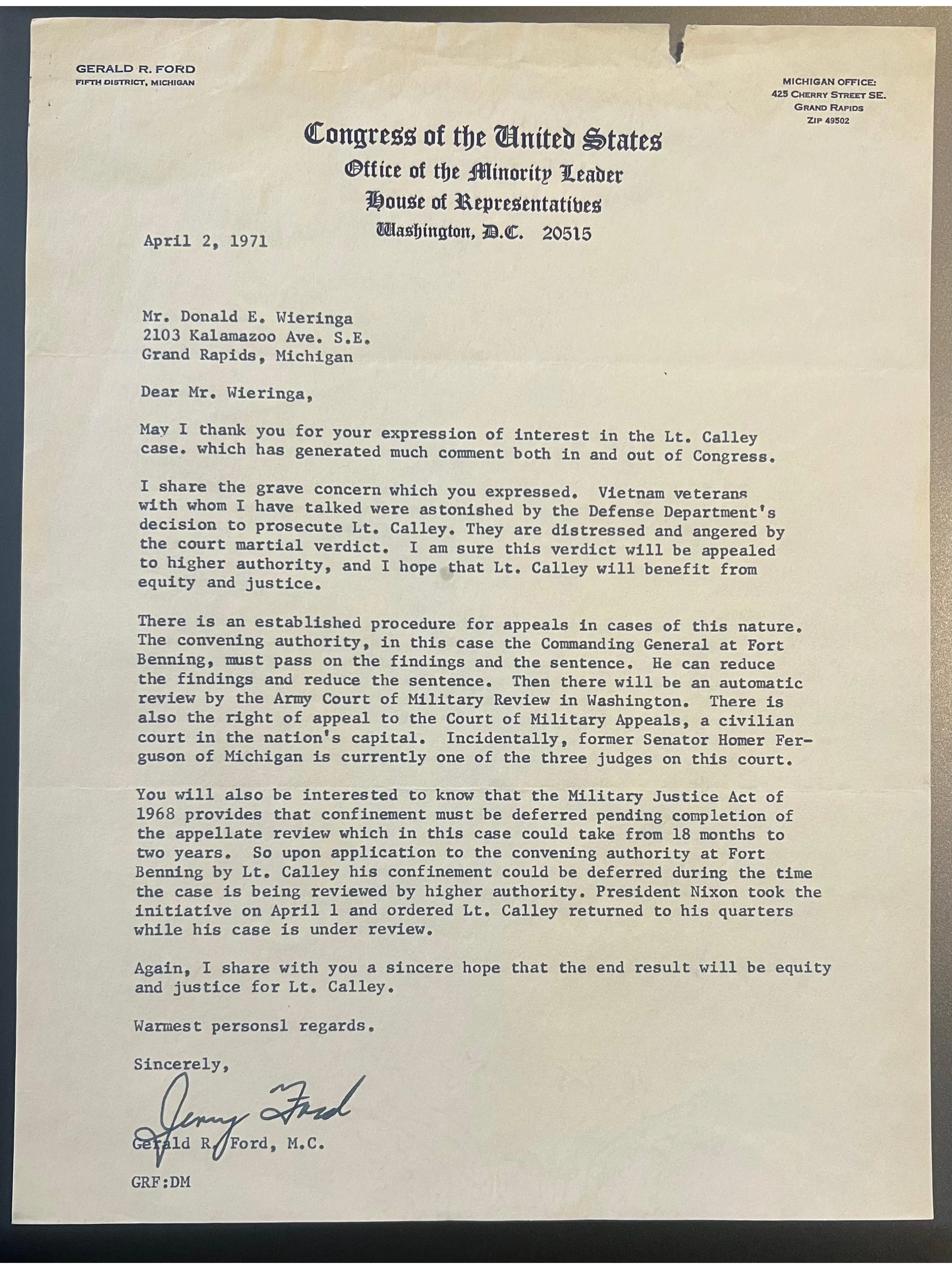
38th President. Typed letter signed “Jerry Ford” as House of Representatives Minority Leader, April 2, 1971, 8×10.5, to a Grand Rapids, Michigan constituent, about the court-martial of American officer and war criminal William Calley Jr., charged with the premeditated killings of 22 unarmed South Vietnamese civilians in the My Lai massacre. Sharing the sender’s outrage regarding Calley’s prosecution, Ford writes in full:
May I thank you for your expression of interest in the Lt. Calley case. which has generated much comment in and out of Congress.
I share the grave concern which you have expressed. Vietnam veterans with whom I have talked were astonished by the Defense Department’s decision to prosecute Lt. Calley. They are distressed and angered by the court-martial verdict. I am sure this verdict will be appealed to higher authority, and I hope that Lt. Calley will benefit from equity and justice.
There is an established procedure for appeals in cases of this nature. The convening authority, in this case the Commanding General at Fort Benning, must pass on the findings and the sentence. Then there will be an automatic review by the Army Court of Military Review in Washington. There is also the right of appeal to the Court of Military Appeals, a civilian court in the nation’s capital. Incidentally, former Senator Homer Ferguson of Michigan is currently one of the three judges on this court.
You will be interested to know that the Military Justice Act of 1968 provides that confinement must be deferred pending completion of the appellate review which in this case could take from 18 months to two years. So upon application to the convening authority at Fort Benning by Lt. Calley his confinement could be deferred during the time the case is being reviewed by higher authority. President Nixon took the initiative on April 1 [one day before this letter was sent] and ordered Lt. Calley returned to his quarters while his case is under review.
Again, I share with you a sincere hope that the end result will be equity and justice for Lt. Calley.
As many as 500 villagers – mostly women, children, infants, and the elderly – had been systematically killed by U.S. soldiers at My Lai, yet of the 26 officers and soldiers charged for their part in the massacre or subsequent cover-up, Calley was the only one convicted. Calley was sentenced to life in prison on March 31, 1971 – just 2 days before Ford sent this letter.
Calley is considered by many as the most notorious war criminal in US history. Nixon did not pardon Calley nor did he commute his sentence. He merely changed his conditions of confinement after his conviction and pending appeal – which remains controversial to this day.
An incredible Vietnam letter.
Small edge bite at top.
** SENT 1 DAY AFTER PRESIDENT NIXON HAD CALLEY REMOVED FROM PRISON & PLACED UNDER HOUSE ARREST **
38th President. Typed letter signed “Jerry Ford” as House of Representatives Minority Leader, April 2, 1971, 8×10.5, to a Grand Rapids, Michigan constituent, about the court-martial of American officer and war criminal William Calley Jr., charged with the premeditated killings of 22 unarmed South Vietnamese civilians in the My Lai massacre. Sharing the sender’s outrage regarding Calley’s prosecution, Ford writes in full:
May I thank you for your expression of interest in the Lt. Calley case. which has generated much comment in and out of Congress.
I share the grave concern which you have expressed. Vietnam veterans with whom I have talked were astonished by the Defense Department’s decision to prosecute Lt. Calley. They are distressed and angered by the court-martial verdict. I am sure this verdict will be appealed to higher authority, and I hope that Lt. Calley will benefit from equity and justice.
There is an established procedure for appeals in cases of this nature. The convening authority, in this case the Commanding General at Fort Benning, must pass on the findings and the sentence. Then there will be an automatic review by the Army Court of Military Review in Washington. There is also the right of appeal to the Court of Military Appeals, a civilian court in the nation’s capital. Incidentally, former Senator Homer Ferguson of Michigan is currently one of the three judges on this court.
You will be interested to know that the Military Justice Act of 1968 provides that confinement must be deferred pending completion of the appellate review which in this case could take from 18 months to two years. So upon application to the convening authority at Fort Benning by Lt. Calley his confinement could be deferred during the time the case is being reviewed by higher authority. President Nixon took the initiative on April 1 [one day before this letter was sent] and ordered Lt. Calley returned to his quarters while his case is under review.
Again, I share with you a sincere hope that the end result will be equity and justice for Lt. Calley.
As many as 500 villagers – mostly women, children, infants, and the elderly – had been systematically killed by U.S. soldiers at My Lai, yet of the 26 officers and soldiers charged for their part in the massacre or subsequent cover-up, Calley was the only one convicted. Calley was sentenced to life in prison on March 31, 1971 – just 2 days before Ford sent this letter.
Calley is considered by many as the most notorious war criminal in US history. Nixon did not pardon Calley nor did he commute his sentence. He merely changed his conditions of confinement after his conviction and pending appeal – which remains controversial to this day.
An incredible Vietnam letter.
Small edge bite at top.