
 Image 1 of 2
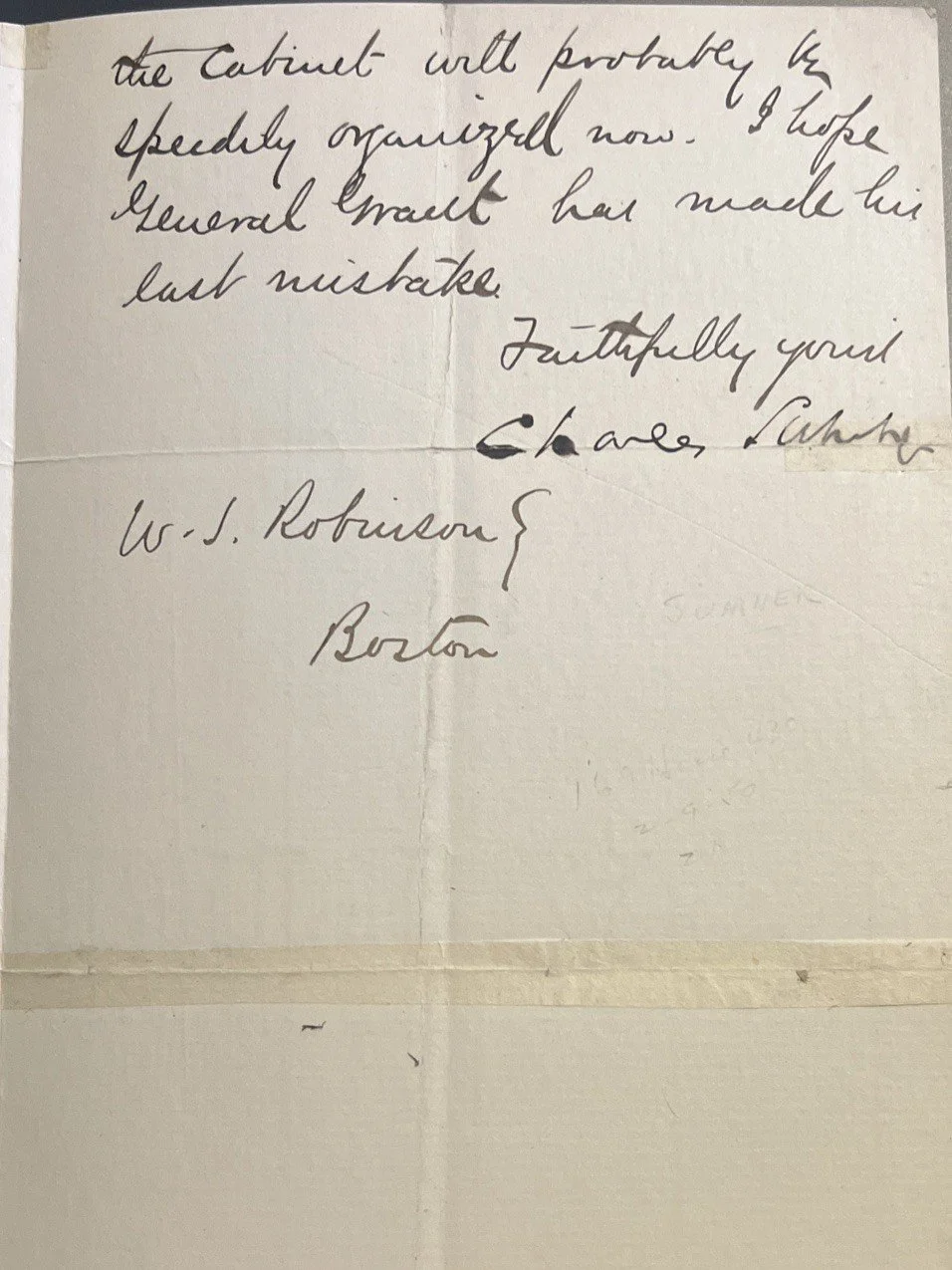 Image 2 of 2
** GREAT LETTER BEFORE THE “SUMNER-GRANT FEUD” WOULD IGNITE **
American politician (1811–1874) and Massachusetts senator best known as a radical Republican and a staunch opponent of slavery.
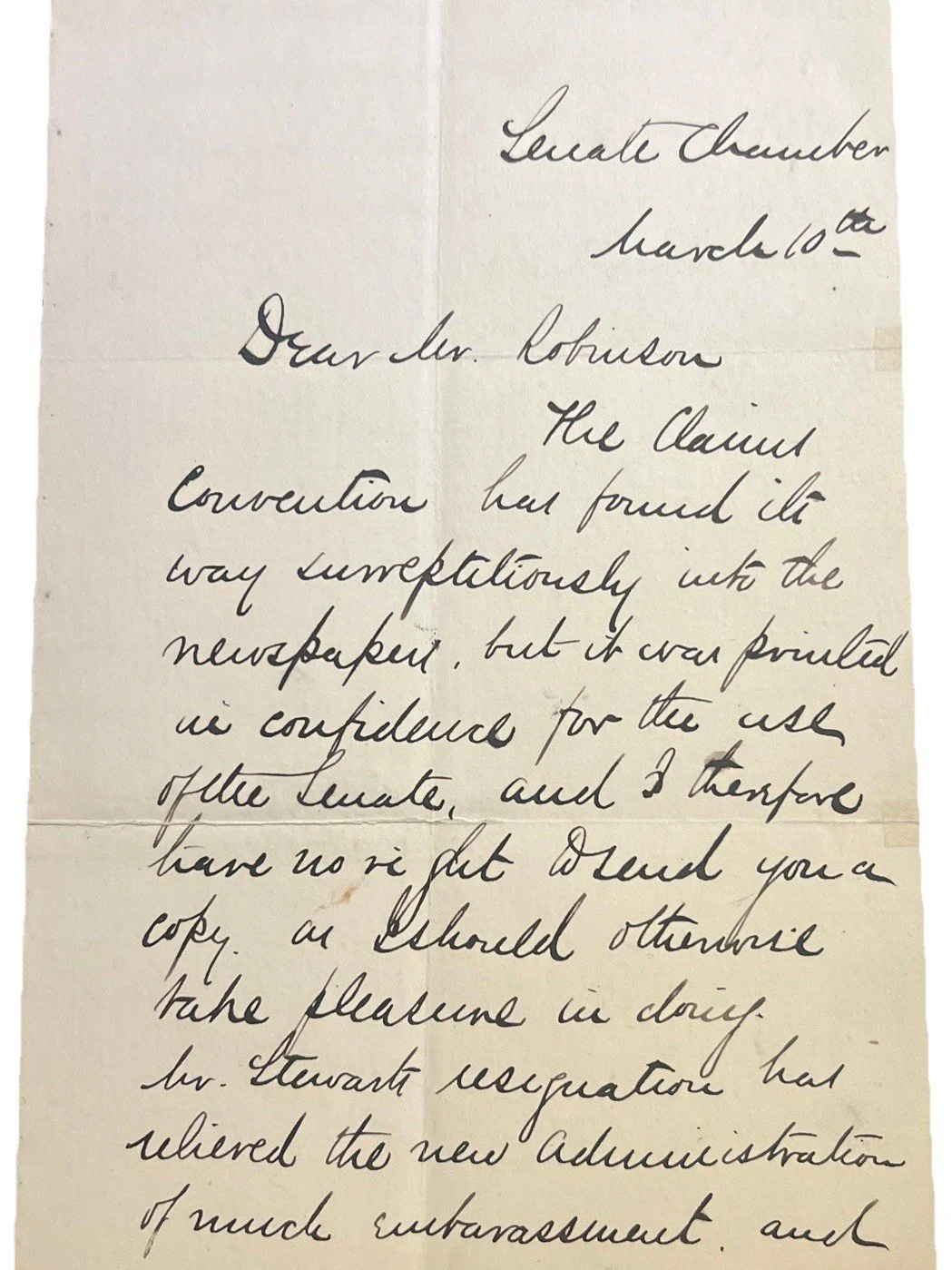
Two-page autograph letter signed “Charles Sumner”, 1st and 3rd pages of a four-page leaf, March 10 [1869], sent from the Senate Chamber to W.J. Robinson in Boston, in full:
The Claims Convention has found its way surreptitiously with the newspaper, but it was printed in confidence for the use of the Senate, and I therefore have no right to send you a copy, or I should otherwise take pleasure in doing. Mr. Stewarts resignation has relieved the new administration of much embarrassment, and the Cabinet will probably be speedily organized now. I hope General Grant has made his last mistake.
Although no year is noted by Sumner, we can surmise this is from 1869 as Grant’s Inauguration was held on March 4, 1869 and Sumner was commenting on the early days of his term.
Folds, tape repair to a horizontal fold which goes over the last name in the signature.
Some historical notes on this letter:
* The “Claims Convention” refers to the Johnson-Clarendon Convention, a treaty negotiated under President Andrew Johnson to settle American claims against Britain arising from the Civil War - especially the Alabama Claims, involving British-built Confederate raiders. Sumner hated this treaty. He thought it was far too soft on Britain.
* The reference to “Mr. Stewart” refers to Alexander T. Stewart, Grant’s choice for Secretary of the Treasury. Stewart was a wealthy New York merchant - one of the richest men in America. But there was a problem: by law, a merchant could not serve as Secretary of the Treasury. This was a major blunder by Grant but Stewart’s resignation spared Grant a greater humiliation.
* Sumner ends the letter with his pointed comment about Grant - as Sumner was weary of Grant’s political capabilities and saw him stumbling at the start, this is a most interesting line from Sumner.
** GREAT LETTER BEFORE THE “SUMNER-GRANT FEUD” WOULD IGNITE **
American politician (1811–1874) and Massachusetts senator best known as a radical Republican and a staunch opponent of slavery.
Two-page autograph letter signed “Charles Sumner”, 1st and 3rd pages of a four-page leaf, March 10 [1869], sent from the Senate Chamber to W.J. Robinson in Boston, in full:
The Claims Convention has found its way surreptitiously with the newspaper, but it was printed in confidence for the use of the Senate, and I therefore have no right to send you a copy, or I should otherwise take pleasure in doing. Mr. Stewarts resignation has relieved the new administration of much embarrassment, and the Cabinet will probably be speedily organized now. I hope General Grant has made his last mistake.
Although no year is noted by Sumner, we can surmise this is from 1869 as Grant’s Inauguration was held on March 4, 1869 and Sumner was commenting on the early days of his term.
Folds, tape repair to a horizontal fold which goes over the last name in the signature.
Some historical notes on this letter:
* The “Claims Convention” refers to the Johnson-Clarendon Convention, a treaty negotiated under President Andrew Johnson to settle American claims against Britain arising from the Civil War - especially the Alabama Claims, involving British-built Confederate raiders. Sumner hated this treaty. He thought it was far too soft on Britain.
* The reference to “Mr. Stewart” refers to Alexander T. Stewart, Grant’s choice for Secretary of the Treasury. Stewart was a wealthy New York merchant - one of the richest men in America. But there was a problem: by law, a merchant could not serve as Secretary of the Treasury. This was a major blunder by Grant but Stewart’s resignation spared Grant a greater humiliation.
* Sumner ends the letter with his pointed comment about Grant - as Sumner was weary of Grant’s political capabilities and saw him stumbling at the start, this is a most interesting line from Sumner.