
 Image 1 of 2
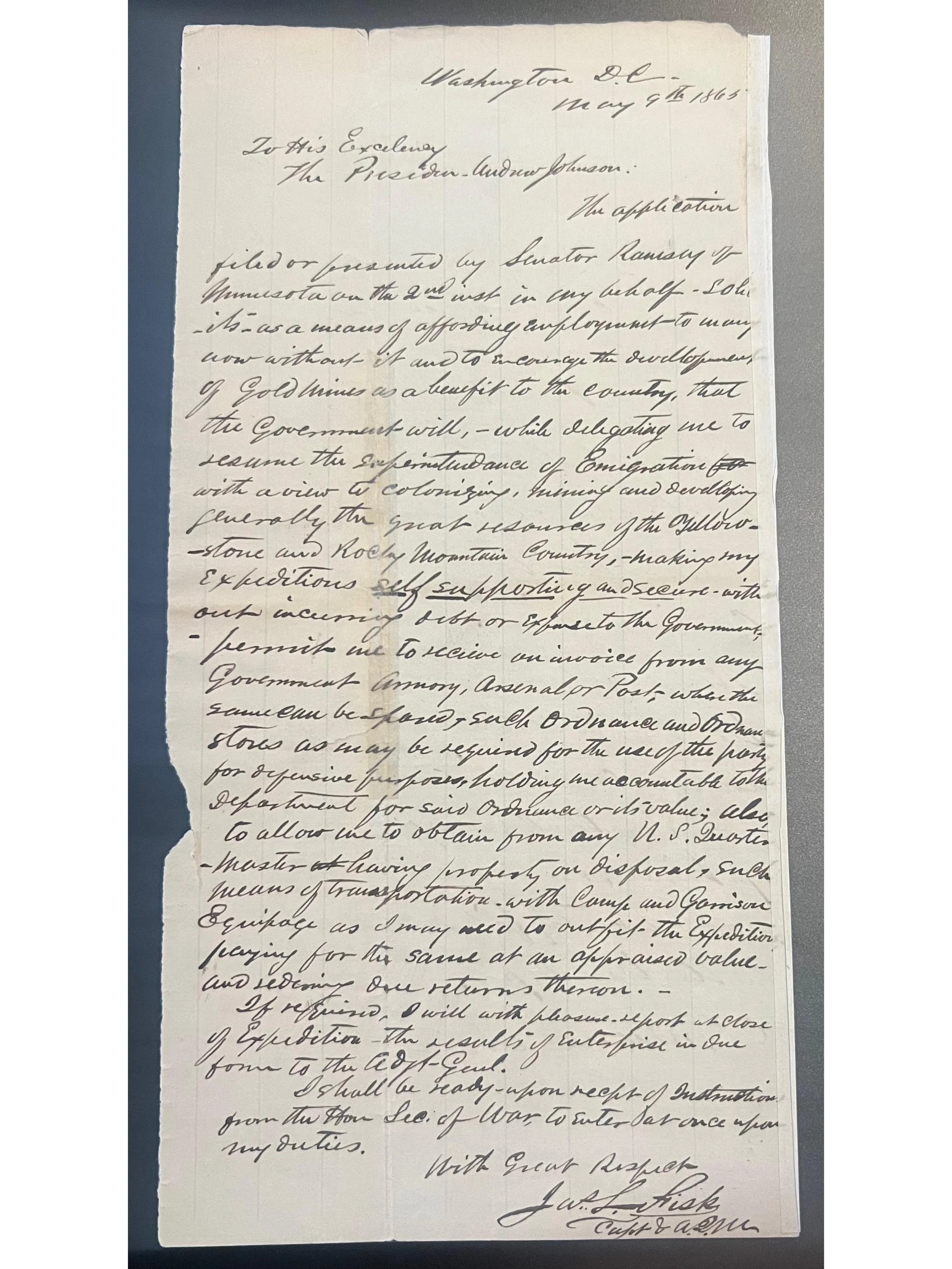 Image 2 of 2
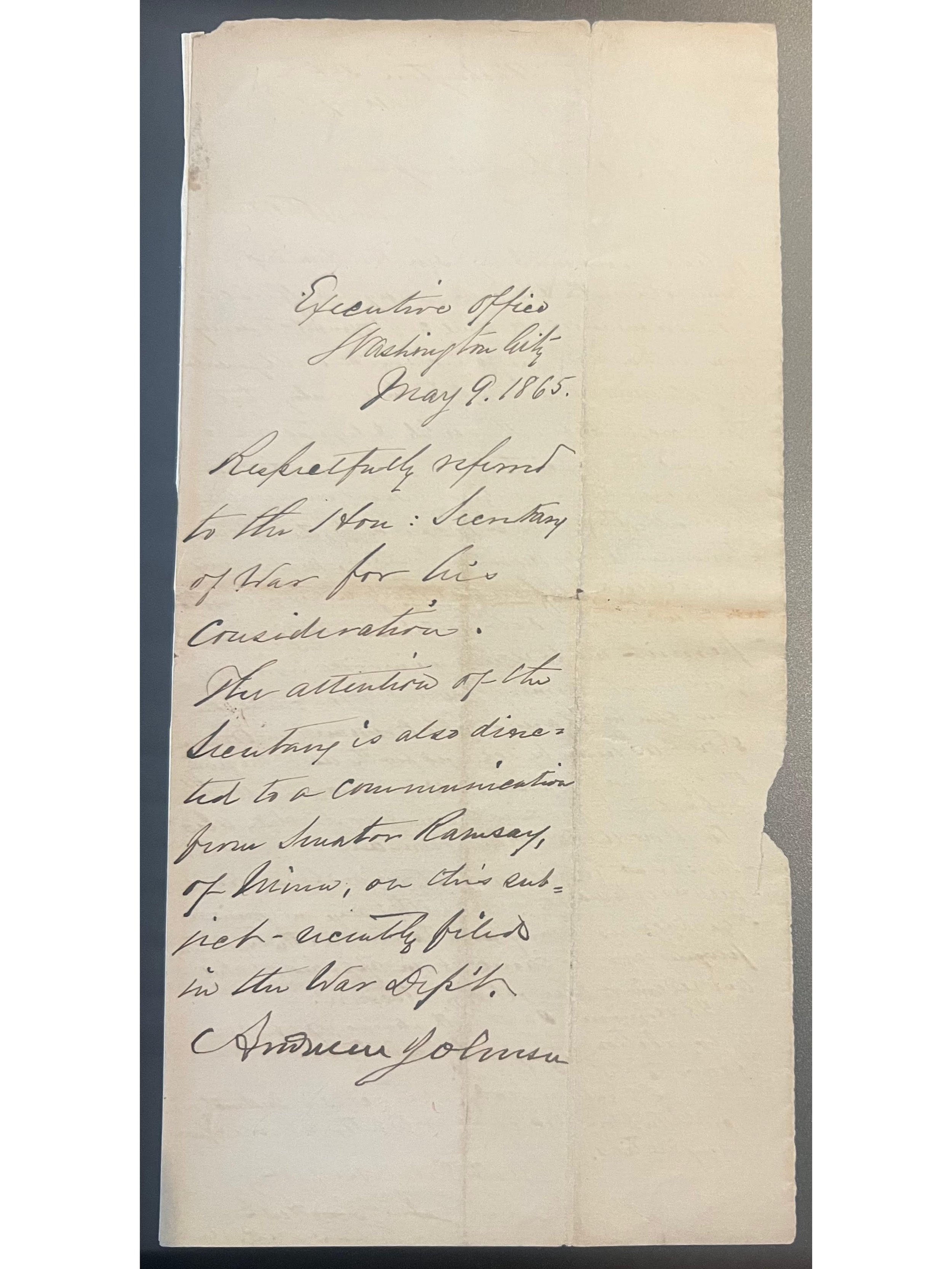
17th President. Autograph endorsement signed “Andrew Johnson” AS PRESIDENT, one page, 4x8, May 9, 1865. President Johnson responds to a letter addressed to him on verso from Union Army officer James L. Fisk, in full:
Executive office
Washington City
May 9. 1865.
Respectfully referred
to the Hon: Secretary
of War for his
consideration.
The attention of the
Secretary is also direc-
ted to a communication
from Senator Ramsay,
of Minn, on this sub-
ject – [?] filed
in the War Dep’t.
Andrew Johnson
Fisk was a Union Army officer who promoted settlement of the western United States. He led four expeditions from Minnesota to Montana in the 1860s.
The letter which prompted President Johnson’s response offers great detail on Fisk’s plans for an expedition. He writes, in part:
The application filed or presented by Senator Ramsay of Minnesota on the 2nd inst. in my behalf…as a means of affording employment to many now without it and to encourage the development of Gold Mines as a benefit to the country, that the Government will, while delegating me to resume the superintendence of Emigration with a view to colonizing, mining and developing generally the great resources of the Yellowstone and Rocky Mountain Country – making my expeditions self supporting and secure – without incurring debt or expense to the Government…allow me to obtain from any U.S. Quartermaster having property on disposal such means of transportation…as I may need to outfit the expedition paying for the same at an appraised value and sending out returns thereon…If required, I will with pleasure report at close of Expedition the results of enterprise in one form to the Adj. Genl…
Amazing early Johnson directive having taken over the Presidency less than one month earlier after the assassination of President Abraham Lincoln.
In very good condition, small edge bites, very small strip of mounting remnant on edge.
On May 9, 1865, President Andrew Johnson issued a proclamation declaring that armed resistance in the South was virtually at an end, marking the commonly accepted conclusion of the American Civil War. This date is often cited as the official end of the war, even though scattered Confederate surrenders continued afterward.
17th President. Autograph endorsement signed “Andrew Johnson” AS PRESIDENT, one page, 4x8, May 9, 1865. President Johnson responds to a letter addressed to him on verso from Union Army officer James L. Fisk, in full:
Executive office
Washington City
May 9. 1865.
Respectfully referred
to the Hon: Secretary
of War for his
consideration.
The attention of the
Secretary is also direc-
ted to a communication
from Senator Ramsay,
of Minn, on this sub-
ject – [?] filed
in the War Dep’t.
Andrew Johnson
Fisk was a Union Army officer who promoted settlement of the western United States. He led four expeditions from Minnesota to Montana in the 1860s.
The letter which prompted President Johnson’s response offers great detail on Fisk’s plans for an expedition. He writes, in part:
The application filed or presented by Senator Ramsay of Minnesota on the 2nd inst. in my behalf…as a means of affording employment to many now without it and to encourage the development of Gold Mines as a benefit to the country, that the Government will, while delegating me to resume the superintendence of Emigration with a view to colonizing, mining and developing generally the great resources of the Yellowstone and Rocky Mountain Country – making my expeditions self supporting and secure – without incurring debt or expense to the Government…allow me to obtain from any U.S. Quartermaster having property on disposal such means of transportation…as I may need to outfit the expedition paying for the same at an appraised value and sending out returns thereon…If required, I will with pleasure report at close of Expedition the results of enterprise in one form to the Adj. Genl…
Amazing early Johnson directive having taken over the Presidency less than one month earlier after the assassination of President Abraham Lincoln.
In very good condition, small edge bites, very small strip of mounting remnant on edge.
On May 9, 1865, President Andrew Johnson issued a proclamation declaring that armed resistance in the South was virtually at an end, marking the commonly accepted conclusion of the American Civil War. This date is often cited as the official end of the war, even though scattered Confederate surrenders continued afterward.